

Today I’m super excited to tell you about another friend’s debut picture book. She is both the author and illustrator of this sweet story and it’s gorgeous!


Welcome Sandra!
Me: What was your artistic journey? When did you start drawing or painting? How did that bring you to this book?
Sandra: I was the sort of child that always enjoyed arts and crafts and when choosing between drawing, writing, and reading, I would always choose drawing. In middle school and high school I got interested in comic art, but it never felt like a viable career option so it was just a hobby I did for 4-6 hours a day. After a semester in college, I had a moment where I decided what was “viable” didn’t matter as much as doing what I wanted with my life, so I transferred to art school.
In my last semester of undergrad, I took a children’s illustration class with LeUyen Pham and I found my path. I didn’t have a children’s portfolio at the time, so I enrolled in grad school to develop a portfolio.
The majority of my artistic progress and finding my style actually happened after art school as I focused more on children’s art and started working in children’s illustration. I don’t think I reached a point where I was routinely satisfied with my work until about 2017, 8 years after graduating with my MFA.


Sandra: The story idea came before the character and there were many variations of Roland over the years. When I start on a project, I often have a general idea of the character, but I need to do many versions before I settle on the right design. In fact, a large part of the development of this book involved reinventing my artistic style to something more simplified and designed, which included the design of Roland.
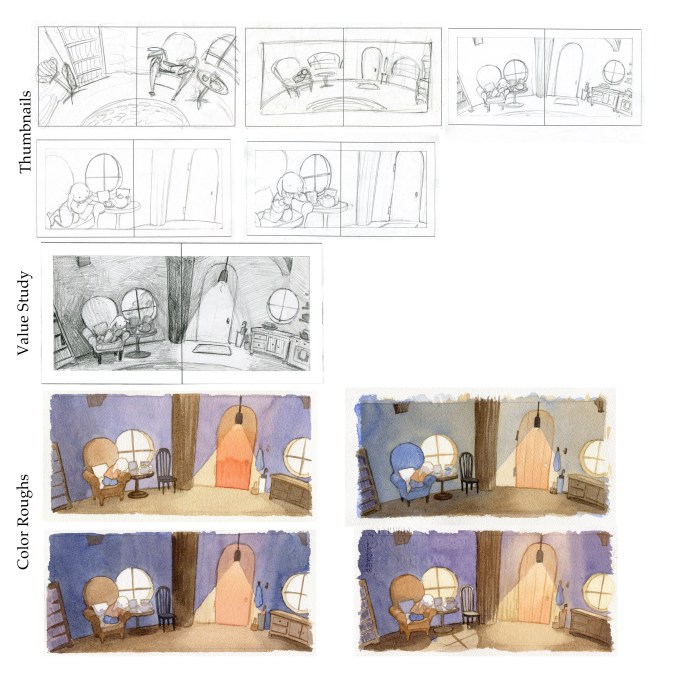
Me: I love the scene where Roland first admits he’s lonely. The lighting and the color are fantastic. I think I remember that one in your portfolio too. Can you talk a bit about what your illustration process for this book looked like?
Sandra: That scene was one of the original test pieces I did for the book back in 2017. It was one of the more challenging scenes because I wanted it to come across as a bit gloomy, while still being colorful and welcoming to readers.


Roland 2017


Roland 2020
My process starts out as thumbnails (I will usually do several different versions), then I will do a larger, more detailed drawing at about ¼ size. I will use that drawing for value studies and color roughs. Then I will blow up that drawing and do a more detailed line drawing, which I scan and print out on watercolor paper or transfer by hand if it’s too big for my printer. Then I go over the line in brown color pencil and paint the scene using four colors: Cadmium Yellow, Scarlet Lake, French Ultramarine, and Burnt Umber.

Me: What is one thing that surprised you in illustrating this story?
Sandra: I think what surprised me the most is how little changed from my dummy to the final version of the book. My dummy was very detailed—almost too detailed. But because I put so much into the initial versions and changed very little after it was acquired, I didn’t spend that much time on the final art for the book. Because the art didn’t need to be changed, I was able to paint the entire book in about 6 weeks (6 weeks where I barely slept, but 6 weeks nonetheless).


Sandra: I think about this question a lot and I haven’t really settled on the answer. For me, learning how to illustrate was far more difficult than learning how to write. A lot of art is muscle memory, so learning the physical act of drawing and painting takes many years. But at this stage, the hardest part for me is coming up with a strong concept that feels fresh and will appeal to children and adults. Once I have a great concept, the writing and the art seem to follow (most of the time).
Me: Any advice for other new picture book illustrators?
Sandra: I think the best advice I would have for new illustrators is to find a style that uses their strengths. I think a lot of artists have an idea of a type of art they enjoy looking at, but it’s not always something that really suits their strengths as an artist. Their path to developing a portfolio ends up being a bit of a battle and they are constantly fighting to fix what’s “wrong.” If people approach style from their strengths, rather than the ideal that they envision in their head, they will create better art sooner.
Me: I love the heart warming choices Roland makes in order to find friends. Is making friends an important topic for you? Why is this something you want to share with kids?


I think the reciprocity of kindness is a truth children understand and the importance of picture books is to reflect the truths children know about themselves.
Community is very important to me and over the years I have found a wonderful community in kid lit. Adults looking to build their kid lit community can look to Roland’s choices as much as children can. How can I lift up the people around me? How can I help my peers succeed? When you care about the people around you, they will care about you in return.
I love that. Absolutely true. I’ve never found a more welcoming group of creators along my writing journey. Thank you for stopping by Sandra.
Dear readers, if you haven’t yet had a chance to pick up this picture book, I highly recommend doing so. It’s a quiet story full of heart that will leave you breathless at its guileless simplicity. It’s stories like this one that leave me reading and re-reading to try and figure out how it was done. Simple is never simple, after all, and this book took years of work to bring to fruition. This is a book to treasure.