

Today I get to interview Danny Popovici, who first stopped by my blog back in 2017 as an illustrator of one of my favorite books. But this time, he’s returning for his author-illustrator debut!
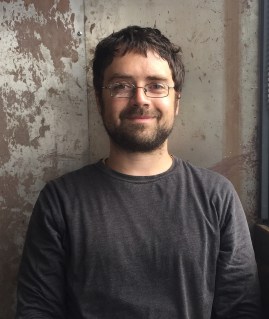


Welcome back Danny!
Me: “The Fox and the Forest Fire” is your picture book author-illustrator debut. Congratulations! What draws you to creating picture books?
Danny: It is my authorial debut, yes; thank you! I can’t tell if that was an intended pun or not, but it really is the “drawing” aspect that draws me to picture book making. Picture book making, more than other media, in my experience, allows for exploration of different mediums. I’ve used different materials to create the final illustrations for each of the picture books I’ve completed so far.
I created my first book, WORLD ON A STRING, using oil paint on canvas boards. My second book, MANJHI MOVES A MOUNTAIN, is watercolor with a touch of colored pencils. And for this book, THE FOX AND THE FOREST FIRE, I used a combination of gouache, watercolor, and colored pencil. My book projects always start out the same though, pencil drawings on paper with notes scribbled on the side. Those drawings generate the mood, and that mood leads me to choose what I think will work best for the final art. I can get bored using the same medium over and over so I love that I can experiment with new materials. Picture books are very accommodating in that way.


Me: Now that you’ve become an author-illustrator, which do you prefer: writing and illustrating your own stories, OR illustrating others’ stories?
Danny: When you receive someone else’s manuscript there is this feeling that half of the hard work is already done, and you can focus solely on the artwork. You don’t have to second guess a line on a page or think about editing characters or places. It’s there and it’s up to you to tell and ideally, expand, the story visually.


Me: Which was harder for this story: writing or drawing?
Danny: I’m still finding my voice as an author but it’s a dream to finally achieve this title, so I’m going to own it! I have been drawing for a long time, so putting down ideas through sketches comes more naturally for me.


Me: Yes it does! I understand you used to be a fire fighter. How long ago did you fight fires? Was that an influence for this story? Where did the idea for this story come from?
Danny: I was a wildland firefighter in the early 2000’s for three seasons. It was an unforgettable experience as I got to be a part of the wilderness very few people get to see. When you’re out there you feel like you’re doing good for the animals and plants that call it home. Wildfires are all too common these days, and it’s a huge strain on the local ecology.
As I wrote in my book, a naturally occurring fire can benefit a forest, but what we’re collectively experiencing these days are not naturally occurring fires. In 2017 a fire raged through the Columbia Gorge here in Oregon and Washington and the smoke was the heaviest I’d experienced within the city. I knew in my heart that the way we’re treating the planet, these fires are only going to get worse and effect more and more people each year.
I knew that I couldn’t fight a fire by making a children’s book about it, but I thought maybe I could try and raise awareness about forest fires, the causes and effects to everyday people, and how we can be more conscious of our environment. A lot of people and animals lose their homes, and some even lose their lives, every year due to preventable fires. The anger and sadness I felt at the time made me feel like I had to write something, anything, to help me process it.
Me: Wow. That’s powerful Danny. I love the way you used your color palette in this story by using a similar red color for both the boy’s hat, the fox, and the fire. Was that always in your plan? Or did that come about in revisions?
Danny: In telling a story about a fire, I knew red/orange was going to be an important and reoccurring color in my palette. But in addition, Oswald, our main protagonist, is having a hard time acclimating to his new environment. So my thinking was that there should be some commonality between him and the fox, something to visually show that they were in it together.

The earth-tone colors were important for the oranges to pop on the page, and when the fire comes, everything is engulfed in orange, creating a sense of chaos and confusion like real fire can create. When I was writing the earliest version of the manuscript, I remember the smoke from the Columbia Gorge was creating an almost otherworldly, orange, sky that felt dire and that influenced how I created the fire scenes in the book.
Me: I love how you have tied the fox into the story visually, but not really in the text. We can see that both the boy and the fox are on the same journey, but the text doesn’t dictate the actions of the fox. Was it hard to leave room for the art and not include everything in the written portion of the story? How did you find the balance between picture and text?
Danny: Writing and revising a book can be a long road; at some point I probably had more about the fox in the text, but ultimately, I thought it was important that I focus on Oswald, to center the story on this child’s journey: both from living in a new place that he doesn’t like very much, to that place becoming “home”, and from feeling very disconnected with nature and the woods, to feeling at one with it. To caring about it and what happens to it. His relationship with the fox helps to communicate both of these journeys. Omitting it from the text lets the reader discover that part of the story as it’s unfolding. Our readers are smart, and I wanted to let them interpret Oswald and the fox’s relationship without me over explaining it.

Me: I love that! What is one thing that surprised you in creating this story?
Danny: When I first began working on what is now The Fox and the Forest Fire, I didn’t really think anything would come of it, in a professional, publishing sense. So many people think of wildfires as a topic for grownups, even though they affect everybody within a community. So, when Ariel Richardson, my wonderful editor at Chronicle Books, expressed interest in making my story into a real live book I was really pleasantly surprised.
Kids are resilient and can handle certain topics a lot better than we sometimes give them credit for. The world is a new place to them, so their frame of reference is different than ours. We might experience wildfires and think there’s no hope, but I believe a child knows there’s hope even in the harshest situations. I never felt like I had to tiptoe around this topic, though I did aim to present it in an age-appropriate way. I think books that don’t talk down to kids are the ones that stick with children throughout their lives. For me, personally speaking, it was the topics that the adults in my life didn’t think I could process as a child that ended up sticking with me, helping shape my adolescence; it’s my hope that there are kids who connect with my book in this same way.
Yes! I think that is all of our dream. Thank you for stopping by Danny.
Dear readers, if you haven’t had a chance yet to read this book, you must track it down. This is a book that accomplishes so much in a very sparse text. The love of nature, the devastation of the fire, the hope of life going on are all present in this story in a way I haven’t quite seen anywhere else. It’s intelligent and assumes young readers are too. It’s an incredible story that must be read to be believed.