

I may be slightly obsessed with snails at the moment because of a story I’m working on, but when I heard about today’s picture book, I had to know more.


Welcome Katarina!
Me: Can you tell us a little bit about your artistic journey? When did you start creating art? How did that bring you to writing and illustrating this book?


That was where my passion for picture books started. I visited the children’s book library quite often and bookstores became like art galleries for me; I would just spend countless hours there, browsing children’s books. I fell in love with the format, the fact it was so restrictive in a way (the number of pages and the length of text) and yet they could communicate quite profound and difficult themes, with wit and brilliant sense of humor. I started to understand the importance of pacing, tone of voice, character design, creating the right atmosphere for the story, etc. So It was in Edinburgh where I first started to work on picture book projects and the story for UPSIDE DOWN–my first published picture book–was actually created there.
Me: You have a lot of books already published. Can you talk about your art process for this book? Did you use traditional media or digital, or a blend of both? What made you decide to use this medium for this book?


Me: I love Henry! What gave you the idea for this story of a snail who doesn’t have slime?


Me: I love how Henry has a weakness, but he doesn’t let it stop him from achieving his dream. I also love that the plot doesn’t stop at him achieving his dream but keeps going. He develops his own strengths and shares them with others. Was this story always like this? Or did it go through many revisions with your critique group, etc.?
Katarina: There was a lot of editing with this particular book. I made at least seven dummy books before I was satisfied with the story. The initial version stoped with Henry achieving his dream: climbing on top of the tallest flower in the garden. But when I read the dummy book over and over again it didn’t feel right, as if there was something missing.
Our seven year old son, Teddy, helped me to spot the problem. He is autistic, which is a sort of disability in the neurotypical world we live in. I realized that by teaching him how our world works we might make his life easier in the future, but it is also up to the people who surround him to make some effort. I realized it is about some sort of compromise, where we need to find that meeting point where we can learn from one another and mutually enrich our lives. In case of HENRY THE SNAIL, I found out that the story isn’t only about him. It is also about the “society” he lives in. All the other slugs and snails are heroes too, because they accept Henry’s difference and are open minded enough to learn something new from him. Following this line of thought, I ended up adding the scenes where other snails and a slug learn to do the acrobatic stunts from Henry and later on establish their little garden circus.


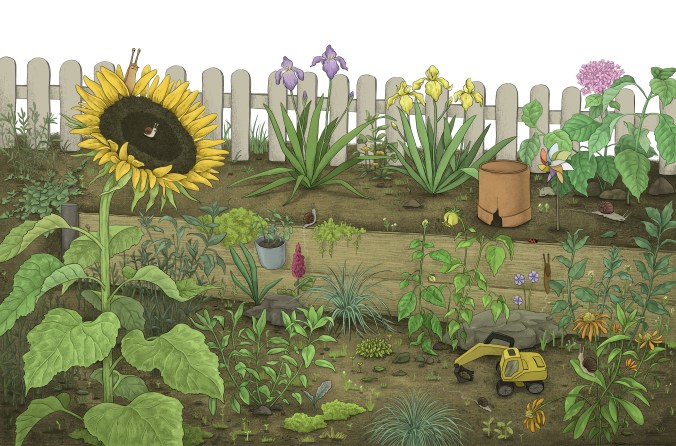
Me: I love that. The garden that you have illustrated with its many plants and insects is beautiful. Did you use reference photos for your illustrations? Or did all of this come purely from your imagination?
Katarina: The garden pictured in the book is our garden two years ago. 🙂 Every plant in the book comes from a sketch of an actual plant that grew in the garden at that time. The only exception is the sunflower which I have tried to grow several times but haven’t yet succeeded.
Me: What is harder for you: writing or illustrating a story?
Katarina: I create illustrations and text simultaneously. So when I make a sketch of a scene that might appear it the book I immediately write text that would accompany it. Creating text and illustrations is a seamless process for me. The most difficult bit is the editing stage, when I already have an idea of how the story would go. I make some initial dummy books. Then I read them back and forth, trying to delete words or parts of scenes that aren’t crucial for the story itself and just try to keep the essential parts. I also try to find the right balance of text and illustration. I want them to complement each other, as opposed to conveying the same information twice for example.
Me: Any advice for new picture book writers and/or illustrators?
Katarina: Be patient. Always carry a sketchbook and walk with your eyes wide open as stories can be found literally anywhere around you. Be open to critique. When working on one story for a year or more, you might get easily stuck. Then it is important to have someone else to give you his/her opinion and possibly point you at the right direction.
Good advice Katarina. Thank you for stopping by my blog today.
Dear readers, if you haven’t read HENRY THE SNAIL yet, I highly recommend it. It’s a quiet story about a snail with a disability, and his determination to make his dreams come true.